
THE NICAN MOPOHUA FACSIMILE REPRODUCTION
For the first time and exclusively: The facsimile reproduction of the oldest copy of the
Nican Mopohua

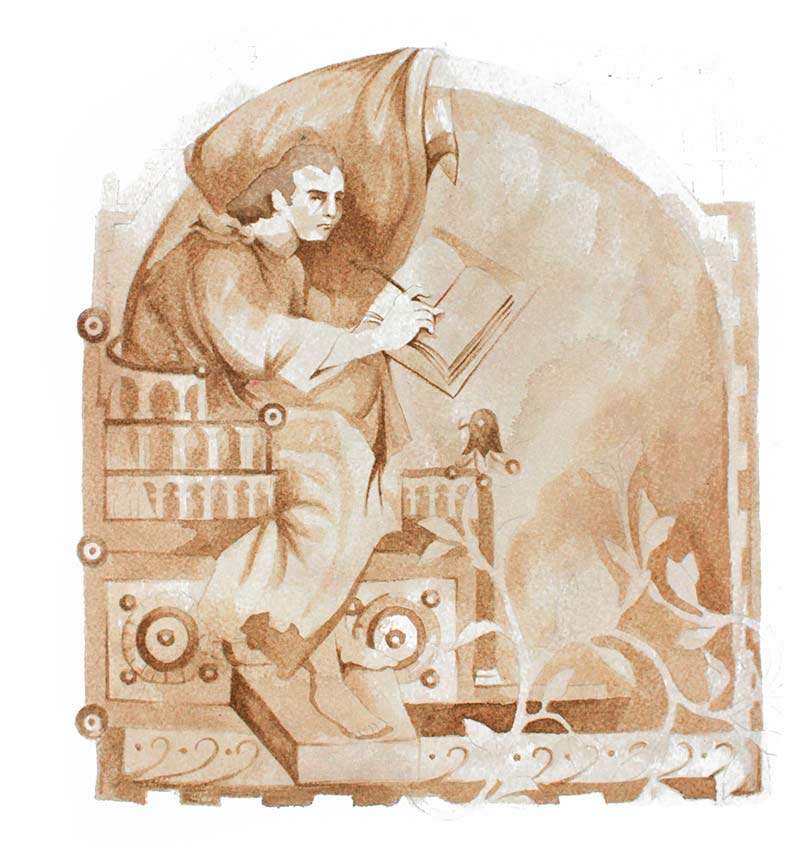
Who wrote the Nican Mopohua?
Luis Lasso de la Vega, chaplain of the sanctuary, publishes the “Inin Huei tlamahuiçoltica omonexiti in ilhuicac tlatocaçihuapilli Santa Maria totlaçonantzin Guadalupe in Nican huei altepenahuac Mexico itocayocan Tepeyacac” (The great event with which the Lady Queen of heaven appeared to her Santa Maria, our beloved Mother of Guadalupe, here near Mexico City, in the place named Tepeyácac), the text in Nahuatl in which the “Great portent” of the apparitions of the Virgin of Guadalupe to the Indian Juan Diego Cuauhtlatoatzin on the Cerro del Tepeyac in the year 1531 is narrated.
This book is actually the union of two writings, namely, the Nican Mopohua, and the Nican Motecpana by Fernando de Alva Ixtlilxóchitl, enriched with slight personal additions by Lasso de la Vega himself, and brought to the presses by Juan Ruyz, the son of Enrico Martínez, in Mexico City, in 1649.
Although Luis Laso de la Vega claims to be the author of the Nican Mopohua in its entirety, however, from the analysis of his work it can be deduced that Lasso de la Vega wrote only the introduction and the conclusion of the book, being practically established by all scholars, that the authorship of the Nican Mopohua, without a doubt, is attributable to the indigenous Antonio Valeriano. (See the Study Guide that accompanies this facsimile for more information).
One of the great treasures of the New York Public Library
Among the many treasures of the New York Public Library, there is a set of documents known as, “Guadalupian Monuments”. Among those , is the Nican Mopohua.

What is the Nican Mopohua?
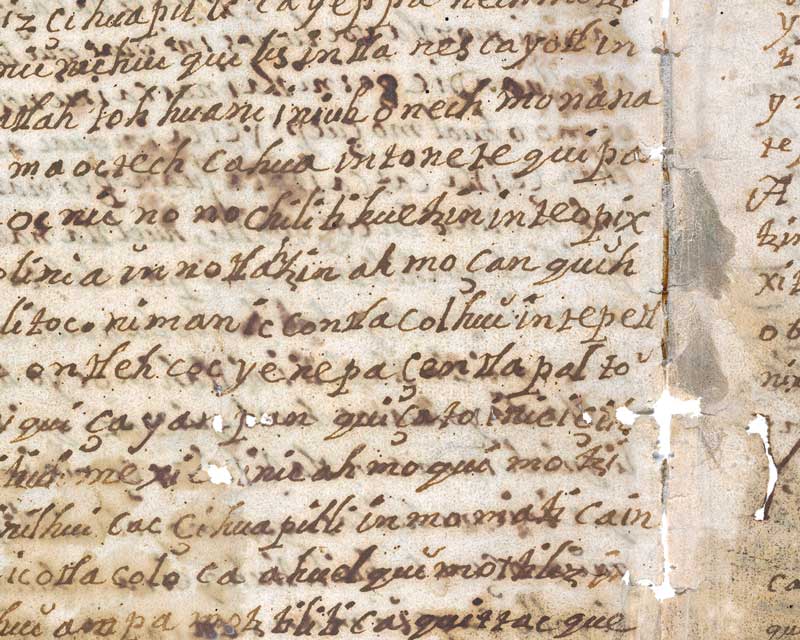
Nican Mopohua, whose meaning corresponds to the words of his first verse: “here it is told”, is the historical document written entirely in Nahuatl, which narrates the divine appearances of Our Lady of Guadalupe to the devout Cuautitlán native, baptized as Juan Diego, in Tepeyac Hill (Mexico), in the year 1531.
It composes of four bifolios (sixteen pages) written in the Nahuatl language, “lingua franca” in Mesoamerica.

What is a facsimile?
A facsimile or facsimile (from the Latin fac simile, ‘to make similar’) is a copy or almost identical reproduction of a document, a book, a map, or a manuscript, generally ancient and of great value.
Thus, there are very valuable manuscripts treasured in museums, libraries and private collections, which we would like to have in our possession because of their great historical, artistic and cultural value.
This not being possible, there are experts, art workshops and specialized publishers who are dedicated precisely to this: to make facsimiles, or unique reproductions, almost identical to those of the original document or manuscript.
A facsimile is an identical copy of an ancient or valuable document. It is also called a reproduction, quasi-original or “clone”.
Why a facsimile of the Nican Mopohua?
The 16 pages that make up the Nican Mopohua (in Nahuatl “here it is narrated, here it is told”), represent, without a doubt, one of the most important historical-religious documents of the Americas. However, no high-quality facsimile reproduction has ever been made.
Despite its immense relevance, this document remains largely unknown to the general public.
Being experts in the reproduction of sacred manuscripts for the Washington Museum of the Bible, we now have the privilege of bringing to light the first facsimile of this monumental work, achieving high levels of perfection and beauty.

THE FACSIMILE
A facsimile is an identical replica or reproduction of an original document. It is made with such precision that it is practically a clone of the original.
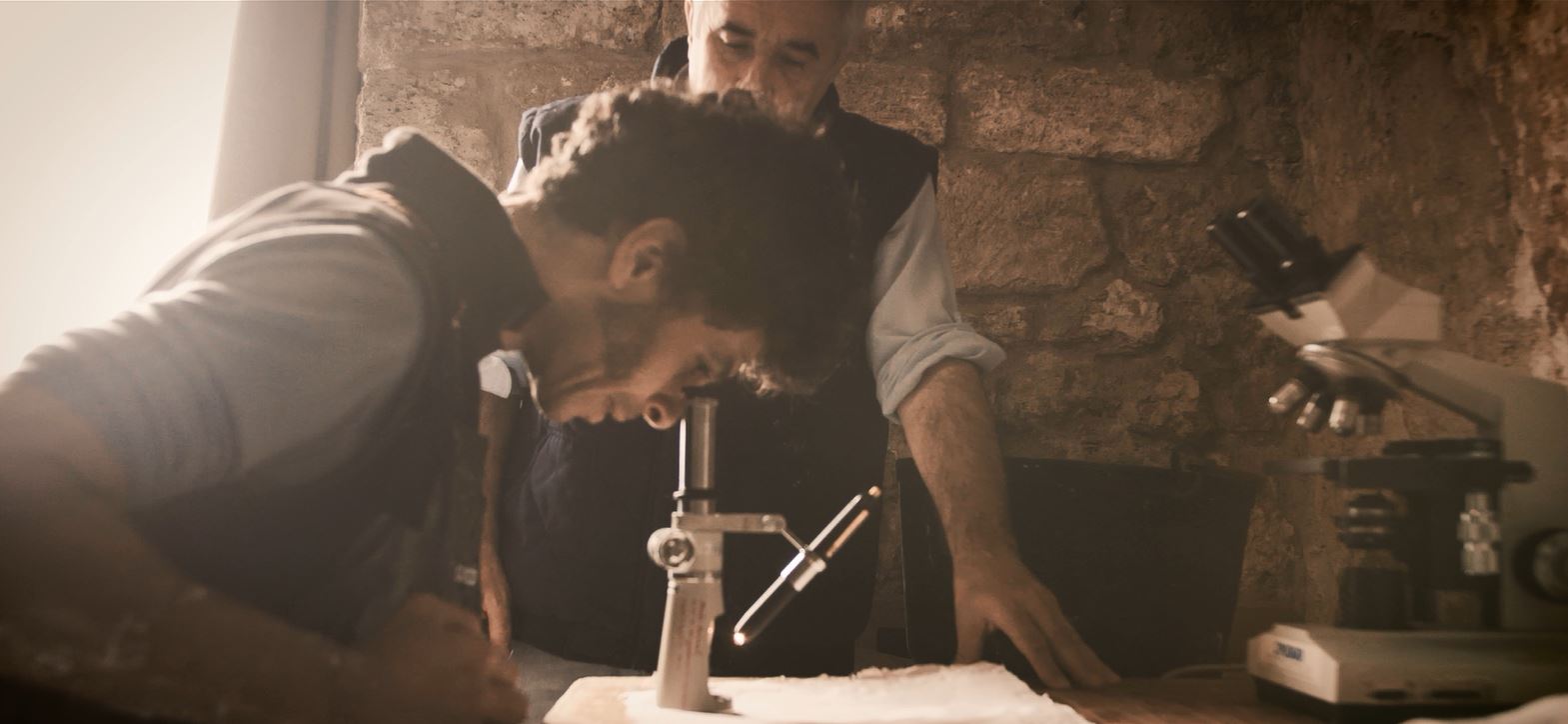
Marino Ayala and Jordi Torrent, masters of Genoese paper making
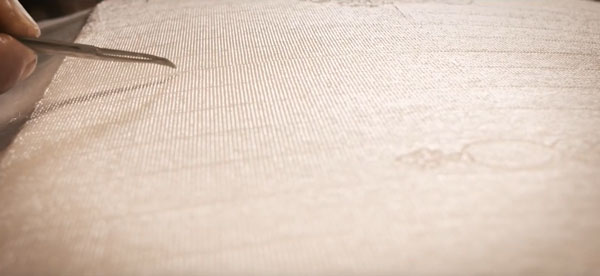
The wet paper, recently removed from the frame, where the watermark can be seen, as well as the horizontal (corondels) and the vertical marks and (punticles).

After 4 years of research, study and craftsmanship,
The Vellum Page presents the New Nican Mopohua
New Nican Mopohua
Museum – Colecting version
Limited edition of 200 unique copies in Spanish, numbered, notarized, and with digital security seal.
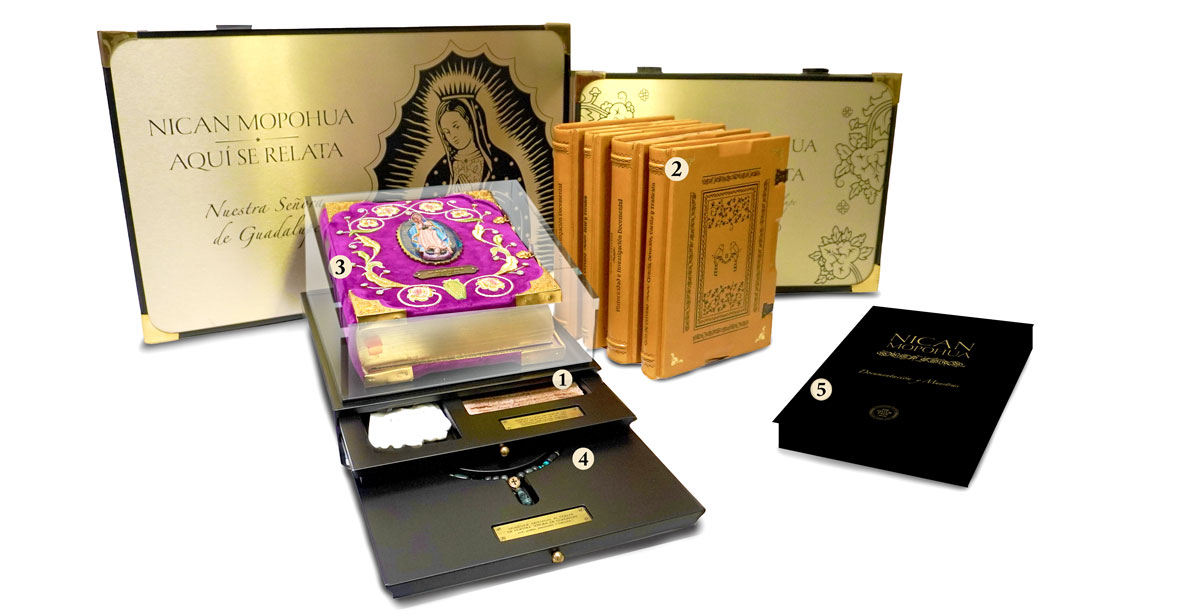
It consists of the following elements:
- A facsimile: handcrafted on Genoese paper.
- A Study Guide: Written by 50 academic experts from various countries, printed on stone paper, bound in luxurious leather and parchment.
- The New Nican Mopohua Manuscript: An artistic interpretation of the manuscript. Written in Nahuatl and Spanish, with the translation of Don Miguel León-Portilla, with more than 200 original illustrations, partially calligraphed and hand-painted, and illuminated with 23k gold. It is adorned with a bronze medallion on the back cover, and corner pieces and clasps in fine gold work. Handmade velvet binding.
- Necklace of the Virgin of Guadalupe: A reproduction-homage to this ornament, made by Mexican artisans with jade, jadeite, amazonite and turquoise.
- Samples of various writing supports: Genovese paper with watermarks, amate paper, stone paper, papyrus and parchment. 6. A piece of “cloth” made with Iczotl (probably the same kind of wild agave fiber used to make Juan Diego’s ayate).
With infinite gratitude
To the more than 50 scholars and experts on Guadalupe and researchers from prestigious universities and institutions around the world.
from prestigious universities and institutions around the world.
And to the more than 15 artists and artisans
WITH THE INVALUABLE COLLABORATION OF


Artesans


Artisans